Physical Address
304 North Cardinal St.
Dorchester Center, MA 02124
Physical Address
304 North Cardinal St.
Dorchester Center, MA 02124

How to find dark pool stocks, judge whether the activity matters, and build a cleaner institutional watchlist in real time.
Updated June 2026 — When traders search for dark pool stocks, what they usually want is simple: which names are seeing unusual institutional activity, how meaningful that activity is, and whether it deserves attention right now. The useful part is not the headline print. The useful part is the process for finding real institutional participation instead of noise.
This guide walks through how to find dark pool stocks in real time, how to judge whether the activity matters, and how to use that information without turning it into fantasy. The goal is not to guess what every print means. The goal is to identify the stocks that deserve a closer look because institutions are actually showing up.
“Dark pool stocks” are simply stocks trading on off-exchange alternative trading systems where institutional participants can execute larger orders with less public market impact. Traders searching for dark pool stocks usually mean something more specific: which stocks are showing unusual dark pool activity today or over the last few sessions?
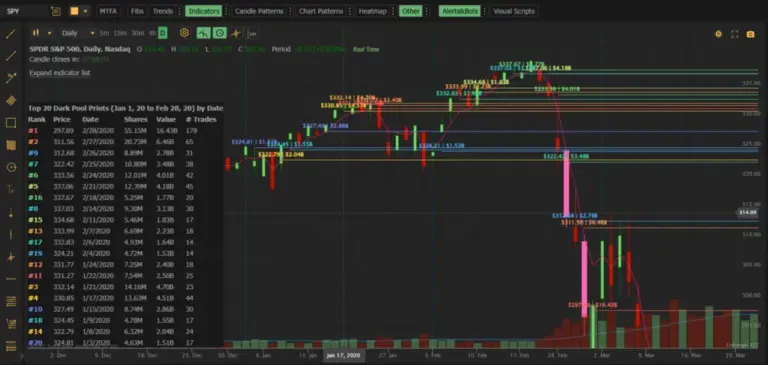
Retail charts show the public market. Dark pool data helps fill in part of the off-exchange activity where larger participants often move inventory. That does not make dark pool data magical. It does make it useful for context. When institutions repeatedly transact around the same price band, that often matters more than a random chart line drawn after the fact.
A $500 million print in a mega-cap name does not mean the same thing as a $50 million print in a lower-volume stock. The core idea is relative activity — how unusual the institutional flow is compared with the stock’s normal behavior.
That is why raw dollar value by itself is not enough. Traders should compare size, repetition, and concentration against typical daily volume and historical dark pool behavior. A smaller print can matter far more if it is exceptional for that stock.
During 2026, several names produced unusually large and concentrated dark pool activity that stood out even in liquid markets. Semiconductor names such as NVDA, AVGO, AMD, and MU showed heavy institutional participation during key windows. Financial names such as BAC and JPM also showed concentrated activity that was meaningful once viewed in relative-size context.
The lesson is not that every large print predicts direction. The lesson is that repeated institutional activity across a stock or sector often creates better watchlists, better levels, and better context than public charts alone.
If the answer is yes to several of those questions, the stock deserves more attention. If not, it may just be another flashy print that looks bigger on social media than it does in context.
The best dark pool stocks to watch are the ones showing unusual institutional activity relative to their normal liquidity, especially when that activity repeats across several prints or lines up with broader sector movement.
A free discovery layer like DarkPoolHeatmap.com is the easiest starting point. It helps you see where institutional activity is concentrated before you commit to deeper tooling.
No. Dark pool prints are best used for context and level analysis, not certainty. Repeated clusters and relative activity matter more than one oversized transaction by itself.
The best dark pool stocks are not just the stocks with the biggest prints. They are the stocks where institutional activity is unusual, repeated, and relevant in context. If you want to find them consistently, focus on relative activity, sector confirmation, repeated levels, and cleaner watchlist construction instead of social-media spectacle.