Physical Address
304 North Cardinal St.
Dorchester Center, MA 02124
Physical Address
304 North Cardinal St.
Dorchester Center, MA 02124
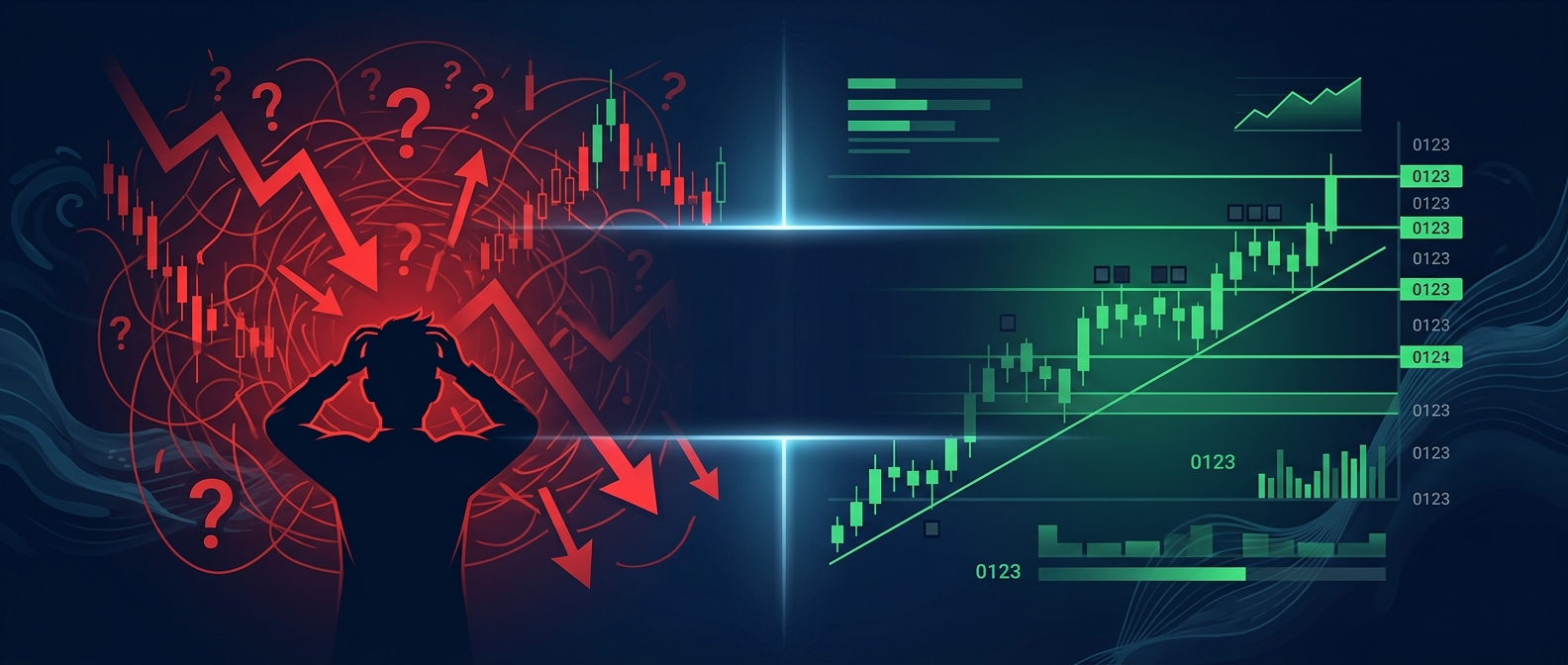
Learn the critical difference between trade predictions and trade setups. Why emotional predictions hurt your trading, and how institutional data creates a real edge.
Based on Dave Barnhart’s June 4, 2026 webinar — “Trade Setups vs Trade Predictions”
Every trader has done it. You read an analyst report, watch a segment on financial television, or scroll through social media, and suddenly you have a conviction about where a stock is headed. It feels like confidence. It feels like you’ve done your homework. It feels decisive.
But what you actually have is a prediction — and predictions come with hidden costs most traders never account for.
Dave Barnhart, founder of MobyTick Trading, has been trading since 2016. His “red pill moment” came early: watching institutional block trades flash across a screen in Stephanie Kammerman’s trading room and realizing there was an entire layer of market activity that retail traders never see. Large institutions weren’t operating on the same information — or the same timeline — as everyone else.
That realization shaped how he approaches the market today. And it starts with understanding the critical distinction between a trade prediction and a trade setup.
A prediction is a claim about an outcome. It’s a statement about the future that asserts certainty in an environment where none exists.
Think about the “Santa Claus rally” narrative that circulates every December. You hear it enough times, and suddenly you’re building a thesis for only one outcome: the market is going up. You haven’t looked at a chart yet. You haven’t checked institutional positioning. But you’ve already mentally spent the money, and your ego is now emotionally committed to a direction.
This is where predictions become dangerous. They don’t just guide a trade — they attach your identity to being right. And when the market does something different, it doesn’t feel like a trading loss. It feels like a personal failure.
In everyday life, beliefs keep us safe. If someone throws a softball at your head, you duck without thinking. If you touch a hot stove, you learn not to do it again. These ingrained responses are efficient — they let you act without paralysis.
But the market doesn’t operate like the physical world. The stove isn’t always hot. Candlestick patterns aren’t 100% reliable — even the best ones have accuracy rates around 70%, meaning they fail three out of every ten times. Technical analysis can break. The market can do anything at any time, and it has no obligation to conform to your expectations.
When you operate from a prediction mindset, three things happen:
In the 1980s, a Chicago radio show called “Gotcha Chicago” ran a social experiment. They placed a man on Madison Avenue — Chicago’s financial district — holding a sign that read “Free Money Today Only.” He stood there with actual cash, offering it to anyone who would take it.
Nobody did.
People crossed the street to avoid him. They rationalized it: “Money doesn’t grow on trees.” “There’s no such thing as free money.” “He must be trying to rob me.” Their beliefs about how the world works made them literally walk away from free cash.
When one person finally took a quarter for a bus transfer, and later someone else took ten dollars, the witnesses couldn’t reconcile it. Their belief — “free money doesn’t exist” — had just been contradicted, and instead of updating their view, they doubled down on rationalizations.
This is exactly what happens when a trade goes against a prediction. The market presents information that contradicts your belief, but instead of adapting, you defend the position. You blame the news, the market makers, the algorithms — anything except the prediction itself.
A trade setup is fundamentally different from a prediction. Here’s why:
The prediction demands to be right. The setup simply needs to be present.
When you trade from setups, you acknowledge that anything can happen. You’re not predicting the future — you’re responding to what the market is doing right now. Your plan already accounts for being wrong, because being wrong is priced into the system as a cost of doing business.
Mark Douglas’s book Trading in the Zone outlines five truths that reframe how traders should think about the market:
When you internalize these truths, the emotional weight of individual trades evaporates. You stop living and dying on each outcome and start focusing on what matters: following a process consistently over a large sample size.
In blackjack, the house has a 0.5% edge over the player. That’s it — half a percent. The pit boss doesn’t come by to check whether you won or lost the last hand. Over a million hands, half a percent is a fortune. The casino trusts the edge, not the outcome of any single bet.
Traders should think the same way. If your system wins 7 out of 10 trades, three consecutive losses isn’t a crisis — it’s within the statistical expectation. But you can only maintain that perspective if you’re trading setups, not predictions. Predictions make every loss personal. Setups make every loss a data point.
So what constitutes a real edge? For Dave, it’s the ability to see where large institutions are positioned.
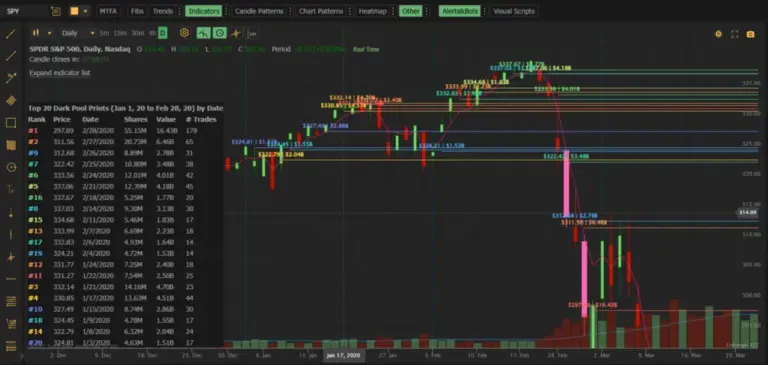
Since 1979, the SEC has allowed institutions to execute massive block trades outside of public exchanges through alternative trading systems known as dark pools. These trades — sometimes hundreds of millions or even billions of dollars in a single print — are completed privately so they don’t move the market against the institution before the order is filled.
By the time these trades are reported, the institution has already established or exited its position. Retail traders who aren’t tracking this data are operating without visibility into where the largest market participants are allocating capital.
The edge isn’t in predicting which way a stock will go. It’s in knowing: here’s where institutions placed billions of dollars. Above this level, the setup favors one direction. Below it, the setup favors the other. There’s no emotional attachment to either outcome. The trade comes to you — you don’t chase it.
When scanning for swing trade setups using institutional data, Dave looks for several criteria:
Critically, the setup is planned before the trade is taken. Entry, stop, and targets are defined in advance. There’s no adjustment mid-trade based on emotion.
| Prediction | Setup |
|---|---|
| You claim to know what happens next | You accept the outcome is unknowable |
| Living in an imagined future | Operating in the present moment |
| Self-worth is on the line | Ego is removed from the equation |
| Risk feels unnecessary because you’re “right” | Risk is defined and accepted in advance |
| You live or die on each individual trade | You think in terms of statistical outcomes over many trades |
| Being wrong triggers defensiveness and blame | Being wrong is neutral — a cost of doing business |
| One outcome must be true | Both outcomes are planned for |
In his book Taming Your Gremlin, Rick Carson offers a deceptively simple technique: simply notice. When you feel the pull toward emotional trading — the fear, the excitement, the need to be right — just notice it. Don’t fight it. Don’t judge it. Just observe that it’s happening.
What this does is create a divide between you and the thought. That voice saying “you should have exited earlier” or “this has to go up” — that’s not you. That’s background noise. Give it a name if it helps. Separate yourself from it. Then return your attention to what the market is actually showing you right now.
Anxiety borrows from a future that hasn’t arrived and a past you can’t change. Trading happens in the present.
When you shift from predictions to setups, the experience of trading changes completely.
It feels calm, not certain. You’re ready for anything because you’ve already planned for it. If condition X is met, you take action Y. You have a stop. You have targets. There’s no drama — it either works or it doesn’t.
It feels almost boring. And that’s the point. If you’re jumping for joy on winners or spiraling on losers, you’re still attached to outcomes. A setup-based approach removes the emotional roller coaster and replaces it with process.
Most importantly, it feels like you have nothing to prove. You’re not trying to be right. You’re trying to be profitable over time. Those are two completely different objectives.
The distinction between predictions and setups isn’t just trading theory — it’s the difference between making decisions based on emotion and making decisions based on process. Predictions feel good in the moment. They give you a sense of conviction and control. But they come with a hidden price: the psychological baggage of needing to be right.
Trade setups don’t promise certainty. They acknowledge that anything can happen, plan for multiple outcomes, and let the edge play out over time. When you trade setups, the market doesn’t owe you anything. You’re not demanding it conform to your view. You’re just taking the trades your system identifies, managing risk, and letting the probabilities work in your favor over a large sample size.
As Dave puts it: “A prediction needs to be right. A trade setup just needs to be present.”
Want to see institutional trading activity for yourself? MobyTick Trading tracks block trades across 10,000+ stocks, with tools for scanning trade setups, setting alerts at institutional levels, and monitoring dark pool activity in real time.