Physical Address
304 North Cardinal St.
Dorchester Center, MA 02124
Physical Address
304 North Cardinal St.
Dorchester Center, MA 02124
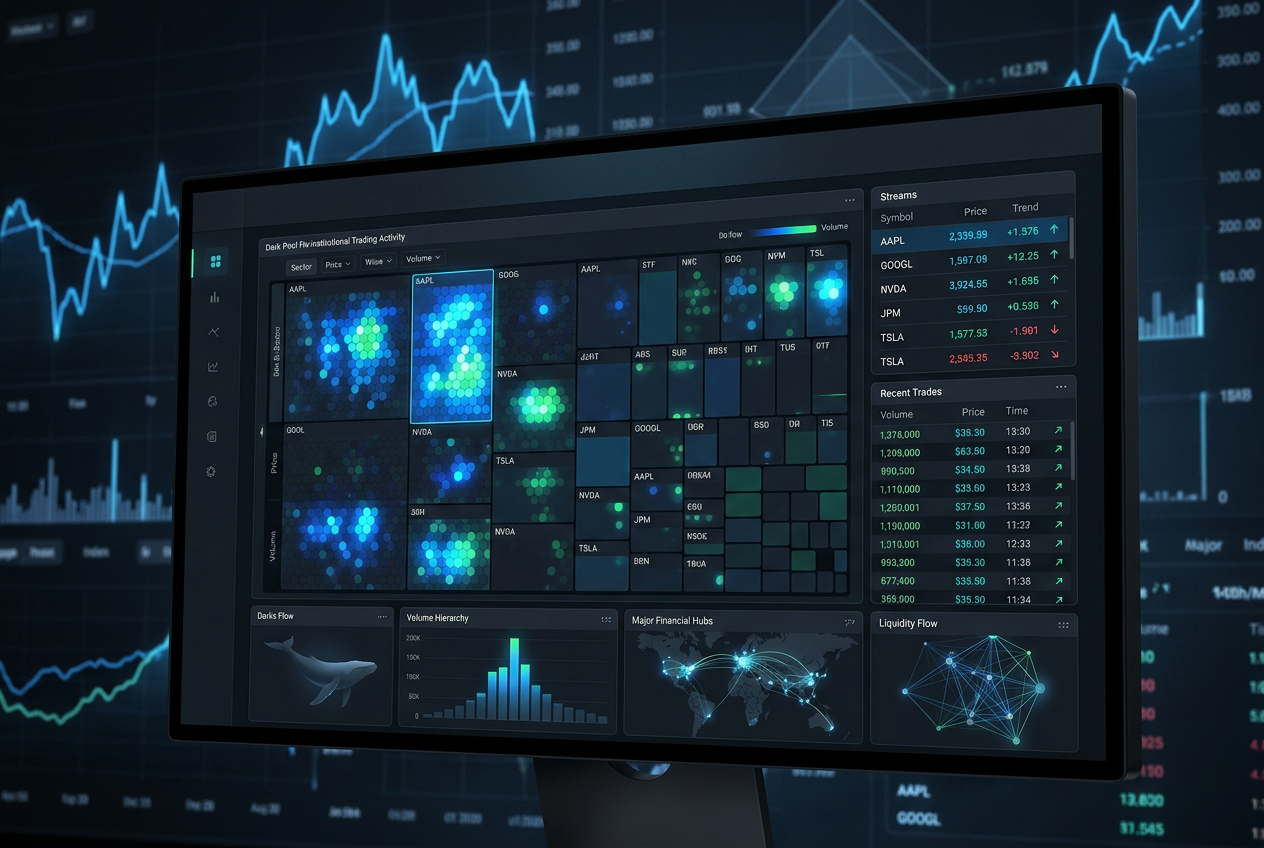
Dark pool data sits in the gap between public charting and institutional execution. For retail traders, it offers a window into where large participants were active — activity that never appeared on the public order book. Understanding this data doesn’t require a finance degree, but it does require the right framework.
This guide covers what dark pool data is, how to interpret it, and how to build it into a practical trading workflow without falling into the trap of over-interpreting a single print.
Dark pools are private trading venues where institutional investors execute large stock transactions without displaying their orders on public exchanges. The goal is to reduce market impact — executing a multi-million-dollar order on a public exchange would move the price against the institution. By trading in dark pools, institutions can get size done without tipping off the rest of the market.
After execution, regulatory reporting requirements mean those trades eventually become visible. That reporting trail is what traders refer to as dark pool data. It shows the ticker, execution price, share count, dollar value, and timestamp of institutional trades that occurred outside the public order book.
This data is delayed, not real-time. But even with a delay, it provides useful context about institutional participation that a standard candlestick chart simply cannot capture.
Here is an actual dark pool print from the week of June 8, 2026:
NVDA: $74.51M — 357,000 shares at $208.71 — Jun 8
Within minutes of each other on the same day, two more NVDA prints appeared: $72.96M (350,000 shares at $208.47) and $72.72M (350,000 shares at $207.78). Three prints totaling roughly $220M in one day, all within a tight $207–$209 range.
That is not random noise. That is a real institutional cluster — and it tells a more specific story than any single print or chart volume bar can convey. A visible chart bar showing NVDA traded 5 million shares that day tells you aggregate activity. Dark pool data shows you the individual institutional blocks that contributed to it: three near-identical size prints at near-identical prices.
A standard volume bar on a chart shows the total number of shares traded during a given period. That includes retail orders, market maker activity, institutional trades, and everything else combined into one aggregate figure. A 5-million-share day on NVDA tells you volume was elevated. It does not tell you how much of that came from institutional block trades versus retail flow.
Dark pool data isolates the institutional component. It shows you individual blocks — their size, their price, their timing — so you can evaluate whether the volume was driven by one large participant quietly accumulating, or by broad retail interest with no single dominant player.
That distinction matters. A $74.51M NVDA print is not just “elevated volume.” It is evidence that a specific institution or set of institutions transacted a specific size at a specific price level. Aggregated volume alone cannot tell you that.
Every dark pool print comes with a set of standard fields. Knowing what each one tells you is the first step in reading the data:
These four fields together create the basic vocabulary of dark pool analysis.
One of the most common mistakes new traders make is overreacting to a large print. A $50 million block sounds dramatic, but its meaning depends entirely on context.
A large print matters only when measured against:
Without that comparative framework, raw size becomes noise. A stock that normally sees $5 million in daily dark pool activity and suddenly prints $50 million is a much more meaningful data point than a mega-cap stock where $50 million is routine background flow.
Not every print is important. Most dark pool activity is routine — institutions adjusting positions, managing risk, or executing standard portfolio transactions. The useful question is not “is this print large?” but “is this print unusual relative to recent behavior?”
Signs that activity may be worth attention include:
Context and repetition are the two filters that turn raw dark pool data into something actually useful.
The most reliable signal in dark pool data is repeated institutional activity at the same price zone. A single large print is interesting. Multiple large prints across sessions at nearly the same price — that is a data point worth marking on a chart.
Consider the SPY activity from the week of June 8, 2026. SPY printed multiple institutional blocks across several days, all tightly clustered in the $733–$743 range:
Four prints totaling over $3.5B across multiple days, all within a 1.3% price range. That is not a coincidence. That is a defined “repeated price zone” — a range where institutions were willing to transact in size repeatedly. When you see that pattern, it becomes a relevant reference level for your chart.
The same pattern appears in individual stocks. Take Apple (AAPL) from the same week:
The Jun 8 cluster at $301–$305 shows over $550M in institutional activity at an upper range. The Jun 9 prints at $288–$293 suggest a different institutional interest zone lower down. Two distinct clusters in the same stock — useful context for understanding where large participants acted on opposite days.
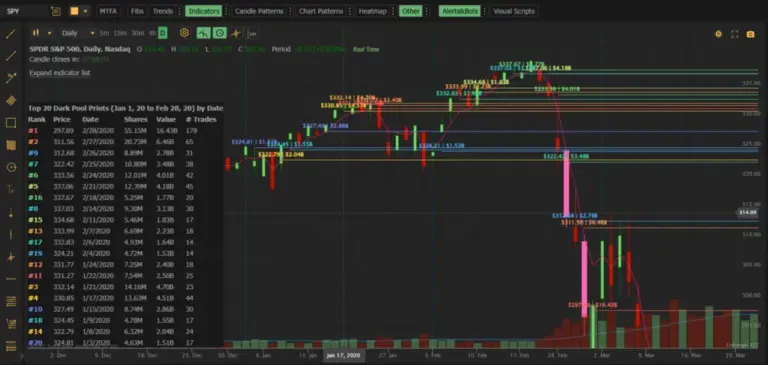
You do not have to reconstruct zones like these by hand. In MobyTick, the largest prints are plotted on each ticker’s price chart automatically, so clusters like the AAPL and SPY examples above appear visually stacked at their price levels the moment you open the chart. You control what’s shown — widen the view to see more prints, narrow it to the biggest blocks, or toggle levels off entirely — which turns “spotting a repeated price zone” from a manual charting exercise into something you can read at a glance.
Another pattern worth noting is “same-size repetition” — when the same dollar value or share count appears in consecutive prints. This often suggests a programmatic or algorithmic execution schedule rather than a one-off decision.
A textbook example from the week of June 8, 2026 is Exxon Mobil (XOM):
Four prints at exactly $79.68M across four separate sessions, with share counts adjusting to match the price movement. That is not human discretion — that is a scheduled program, systematically executing a fixed dollar amount over time. Recognizing this pattern prevents misinterpreting algorithmic execution flows as discretionary directional bets.
The biggest risk with dark pool data is treating every large print as a trading signal. The better approach is to use it as context — something that adds weight to your normal analysis rather than replacing it.
Practical rules:
Yes. Dark pool trades are reported after execution, usually with a regulatory delay. The data shows what institutions already did, not what they are doing right now.
No single data set can do that reliably. Dark pool data helps identify where institutions were active and whether that activity formed price zones worth monitoring. It is context, not prediction.
Less so than for swing trading and position analysis, since the data is delayed. It is more useful for identifying levels and themes over multi-day timeframes.
The price, combined with whether the same price appears in multiple prints. Repeated price zones are more meaningful than any isolated large block.
MobyTick is purpose-built for retail traders who want a practical dark pool research workflow. It tracks 10,000+ stocks, provides six-plus years of historical data for clustering analysis, and automatically plots the top 10 dark pool prints directly on each ticker’s chart by default — with full control over what’s displayed — so the institutional levels and repeated price zones discussed above are visible the moment you open a name, no manual charting required.
Whether you are scanning for sector-level activity, drilling into ticker-level clusters, or monitoring repeated price zones, MobyTick provides the structure to make dark pool data useful — not just interesting.
10,000+ stocks • 6+ years of history • Top prints auto-plotted on every chart • Sector scans • Cluster analysis
Plans from $19.99/month. Free 7-day trial available.