Physical Address
304 North Cardinal St.
Dorchester Center, MA 02124
Physical Address
304 North Cardinal St.
Dorchester Center, MA 02124

“Whale watching” in the stock market refers to monitoring the trading activity of large institutional investors — pension funds, hedge funds, mutual funds, and other entities that trade massive positions. These “whales” execute trades so large they can influence market prices and liquidity. This guide explains how to track institutional trading activity and what it tells you about the market.
Key Insight: Institutional investors account for the majority of trading volume in U.S. equity markets. When they move capital, they leave footprints in dark pool data that can reveal support levels, accumulation patterns, and sector rotation — information invisible to standard charting platforms.
When institutions move capital, they leave signals that can reveal:
For retail traders, whale watching provides a window into the 30-40% of trading activity that happens off public exchanges — in dark pools and Alternative Trading Systems (ATS).
Dark pools are private exchanges where institutional investors execute large orders without displaying their intentions. These venues allow whales to trade millions of shares without alerting other traders who might front-run their orders.
When a pension fund wants to buy 5 million shares of a stock, executing on a public exchange creates problems:
Dark pools solve these problems by matching orders privately. The trades still get reported to FINRA (within 10 seconds under current rules), but without pre-trade visibility.
The key insight: dark pool trades represent executed orders, not pending orders. When you see a whale trade in dark pool data, that institution already has a position at that level. The data shows where capital was committed, not what’s going to happen next.
Here’s actual institutional trading activity from the week of March 16-24, 2026, verified through the MobyTick API:
| Ticker | Shares | Price | Dollar Value | Date | Significance |
|---|---|---|---|---|---|
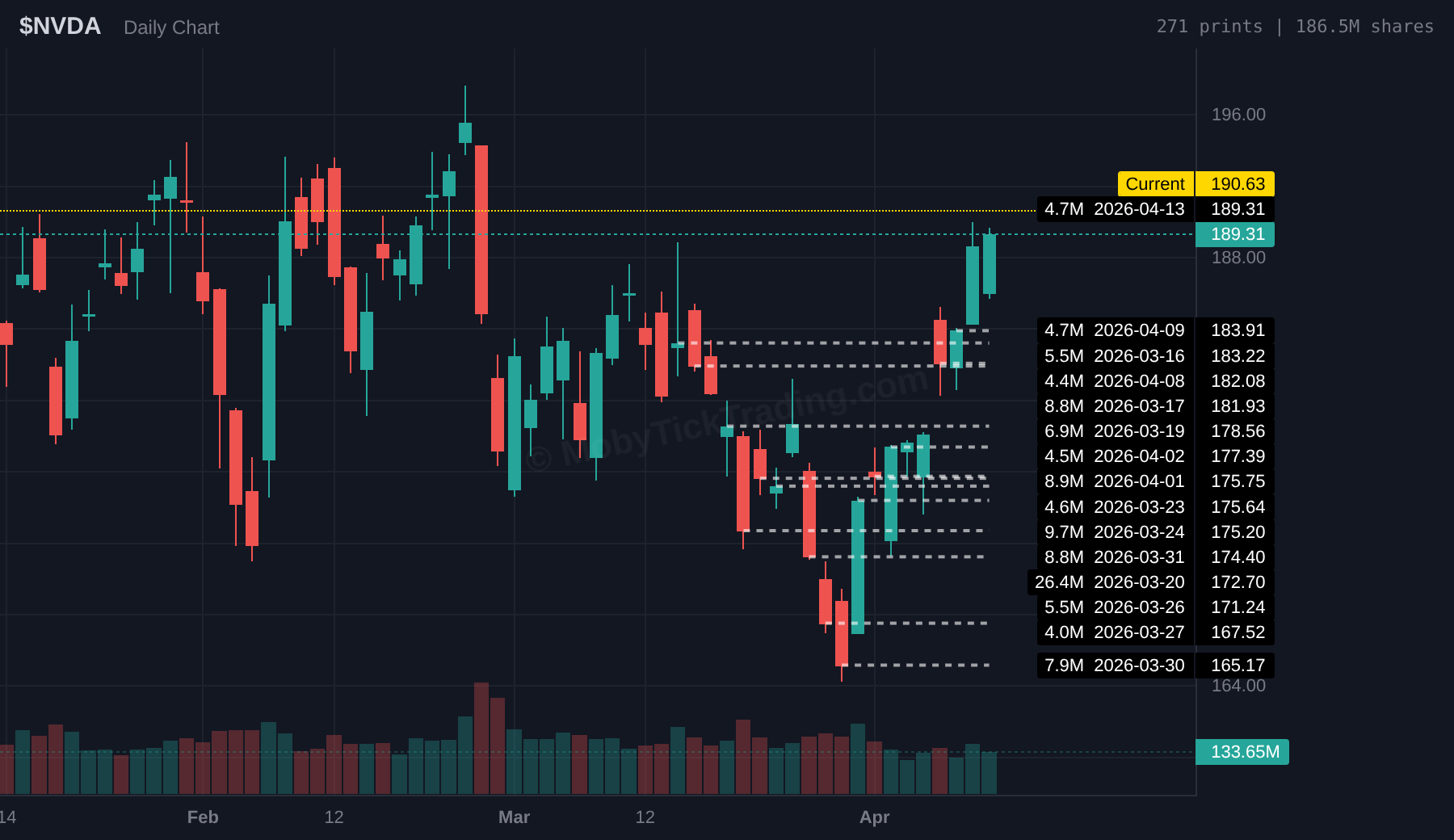
| NVDA | 26.4M | $172.70 | $4.55B | March 20 | Largest 90-day print |
| SPY | 10.6M | $658.02 | $6.96B | March 20 | Largest 90-day print |
| AAPL | 15.8M | $251.64 | $3.98B | March 24 | Largest 30-day print |
| MSFT | 7.3M | $381.87 | $2.77B | March 20 | Largest 30-day print |
| AVGO | 8.2M | $322.79 | $2.64B | March 17 | Largest 30-day print |
| MU | 4.5M | $422.90 | $1.92B | March 20 | Largest 30-day print |
Five of these six stocks had their largest dark pool prints of the tracked period on the same two days — March 20 and March 24. That clustering of institutional activity across multiple names is the kind of signal whale watching reveals.
Beyond individual stocks, dark pool data reveals capital flowing into specific sectors:
Technology / Semiconductors:
Financials:
The semiconductor sector showed over $12 billion in verified dark pool prints across four stocks within a single week — concentrated institutional activity that no public chart makes visible.
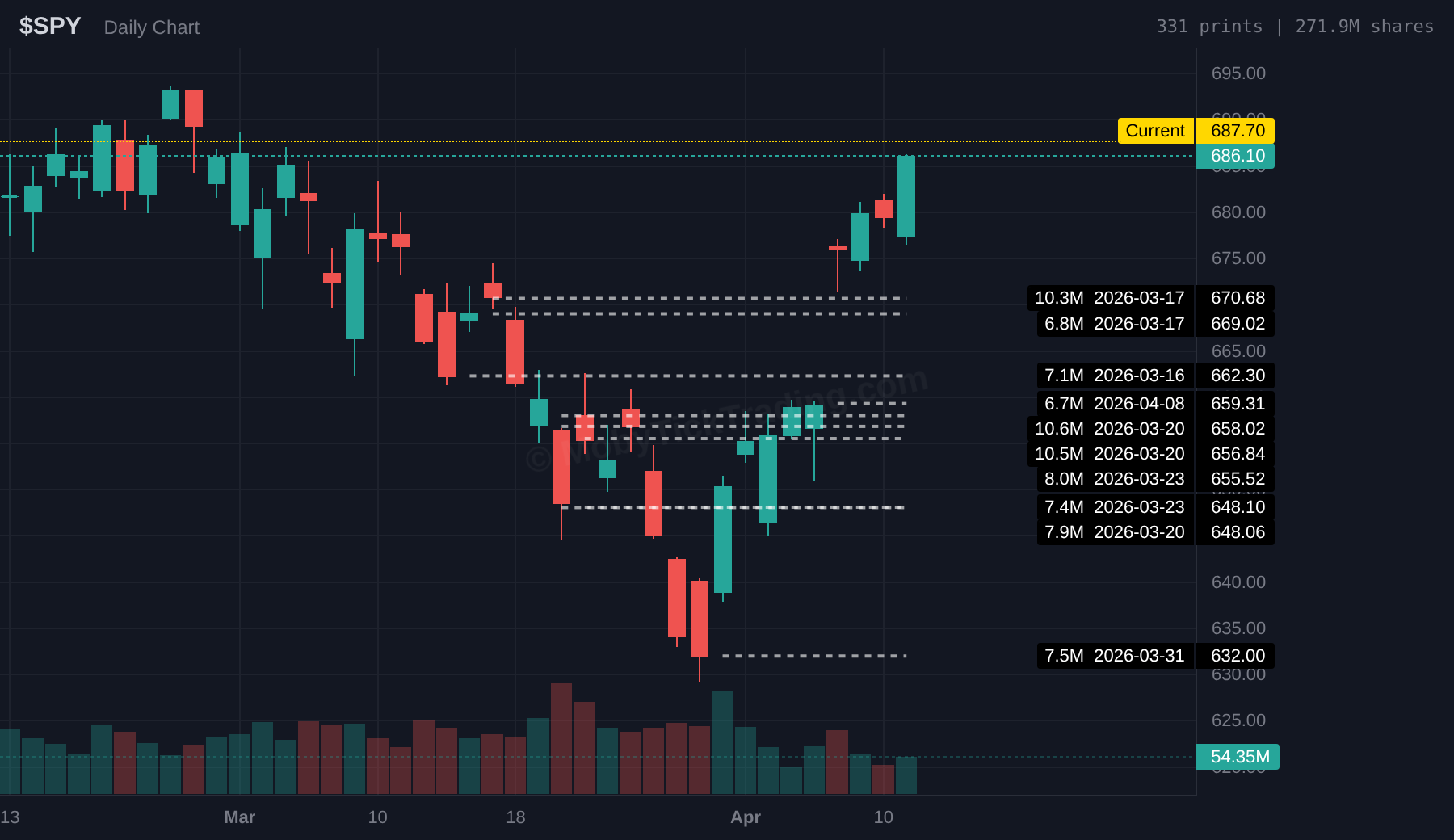
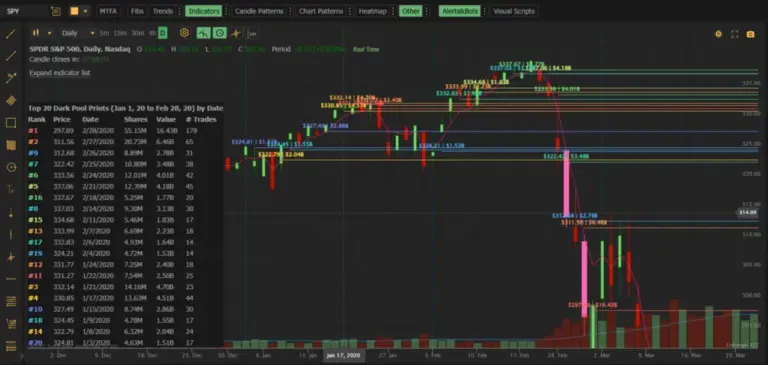
When multiple large prints cluster at a specific price, that level becomes significant. Institutions have positions there.
Example: The $172.70 level in NVDA saw a $4.55 billion dark pool print on March 20 — the largest print in the 90-day tracked period. As of April 14, NVDA trades at $190.63, above this zone. The dark pool data shows where institutional money was positioned during the March weakness.
A single large print could be a one-time rebalancing. Consistent prints at similar prices over weeks indicate systematic position building.
Signs of accumulation:
Some whale trades stand out even among institutional activity. The NVDA $4.55 billion print represents a single institution’s (or coordinated group’s) conviction at a specific level — on a day when the broader market was under pressure.
Dark pool data shows where institutions positioned, not when price will move. The edge comes from combining whale watching with technical analysis, volume context, and other research tools.
| Feature | Why It Matters |
|---|---|
| Coverage | More stocks = more whale sightings. MobyTick tracks 10,000+ tickers. |
| Historical Data | Back-test whether whale levels correlated with subsequent price action. MobyTick has 6+ years. |
| Real-Time Alerts | Know immediately when whales execute large trades. |
| Opening/Closing Filters | Distinguish genuine institutional positioning from mechanical index rebalancing. |
MobyTick provides the coverage and depth needed for serious whale watching:
Can retail traders actually profit from whale watching?
Whale watching provides information about where institutions are positioned, not directional signals. Knowing where whales have positions helps identify significant price levels that may act as support or resistance.
How quickly are dark pool trades reported?
FINRA requires trades to be reported within 10 seconds of execution under current rules.
What counts as a “whale” trade?
There’s no official threshold, but common definitions include: 100,000+ shares per trade, $200,000+ notional value, or 5%+ of average daily volume.
Do whale trades predict market direction?
No. A large print shows execution, not intent. Clustering of prints at specific levels — combined with accumulation patterns — can indicate institutional conviction at those prices.
Is dark pool data legal?
Yes. All dark pool trades are reported to FINRA and become public record.
Whale watching gives retail traders visibility into the 30-40% of market activity that standard platforms miss. It’s not about following institutional trades blindly — it’s about understanding where institutional capital is concentrated, at what levels, and in what concentrations.
The largest players in the market leave footprints. Learning to read those footprints — through dark pool data, block trade tracking, and accumulation analysis — provides an edge that traditional technical analysis alone cannot offer.
See today’s institutional trading activity for free at DarkPoolHeatmap.com — or start a MobyTick trial for real-time alerts, historical analysis, and accumulation signals across 10,000+ stocks.
Get weekly dark pool insights delivered to your inbox. Subscribe to the free MobyTick weekly report.
Data verified against MobyTick API as of April 14, 2026. All dollar values represent aggregate dark pool print values from FINRA Trade Reporting Facility data.