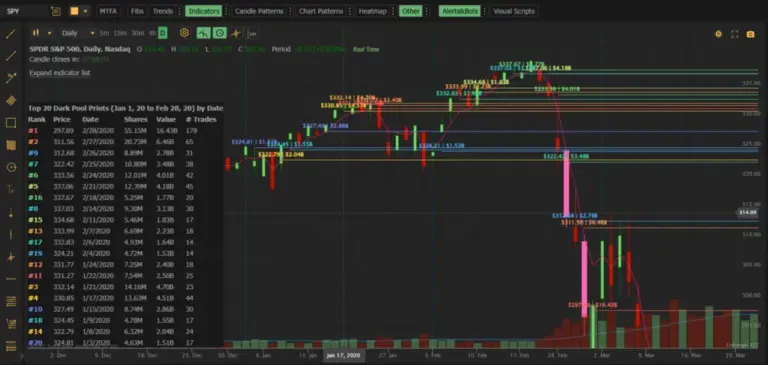
If you are trying to learn how to read dark pool prints, the first thing to understand is this: a dark pool print is not a magic signal.
A dark pool print is a reported transaction tied to off-exchange trading activity, often associated with institutional-sized participation. What makes dark pool data useful is not that one print tells you the future. It is that a group of prints, repeated activity, and price-level clustering can help you understand where large participants have been active.
That is a much more useful way to think about the data.
The goal is not to stare at one big print and invent a story. The goal is to learn what a print actually tells you, what it does not tell you, and how to place it in context.
What is a dark pool print?
A dark pool print is a reported trade tied to off-exchange activity, often involving institutional-sized transactions that do not interact with the public order book in the same way as regular exchange trades.
In the U.S., equity trades still have to be reported. FINRA trade-reporting rules require transactions in equity securities to be reported to facilities such as a Trade Reporting Facility (TRF), and standard reporting windows apply to many trades executed during market hours.
That matters because retail traders usually are not looking at hidden orders before execution. They are looking at reported prints after the fact.
So when traders talk about “reading dark pool prints,” they usually mean interpreting reported block trades or off-exchange transactions in a useful way.
Why do dark pool prints matter?
Dark pool prints matter because they can reveal where large market participants were willing to transact meaningful size.
That can be useful for a few reasons:
- large participants do not usually move size at random
- repeated prints at similar price levels can highlight areas of institutional interest
- dark pool activity can help add context to a ticker’s recent price behavior
- block-trade history can sometimes be more useful than noisy intraday chatter
What matters is not the existence of one print by itself. What matters is the pattern.
What a dark pool print actually tells you
A dark pool print can tell you several practical things:
1. A meaningful transaction happened
At minimum, a print tells you a transaction was reported at a specific price and size.
2. Price matters
If large trades keep showing up around the same price area, that level deserves attention. It can become an important reference point when you review later price action.
3. Size matters
A 20,000-share print in one stock may be routine. The same size in a thinner or lower-volume name may be much more notable. Size only means something in context.
4. Repetition matters
Multiple prints across time can be much more informative than one isolated print.
5. Context matters more than excitement
A large print in SPY is not the same thing as a large print in a smaller-cap stock. You have to judge size relative to the ticker’s normal activity.
What a dark pool print does not tell you
This is where traders get themselves into trouble.
A dark pool print does not automatically tell you:
- that a stock is definitely going higher
- that institutions are definitely bullish or bearish
- that you should copy the trade immediately
- whether the transaction was part of a larger hedge or strategy
- the full intent behind the trade
That last point matters a lot.
A print is a reported transaction. It is not a diary entry from the institution that placed it.
If you try to squeeze certainty out of every print, you will end up hallucinating intent.
How to evaluate a dark pool print in context
The best way to read dark pool prints is to use a simple checklist.
Look at the ticker
Start with the ticker itself.
- Is it liquid?
- Is it highly active already?
- Is it a broad ETF like SPY or QQQ?
- Is it a thinner stock where the same size would stand out more?
Look at the size
Ask whether the trade is large relative to that ticker, not just large in absolute terms.
Look at the price
Where did the print occur?
- near a level that has already mattered?
- inside a cluster of previous institutional activity?
- far away from recent action?
Look for repeat behavior
One print can be interesting. A series of prints near the same level is usually more useful.
Look at timeframe
A print from today may matter differently than a recurring level that has shown up over several weeks or months.
Use other context
Dark pool data works better when combined with:
- recent price structure
- volume behavior
- broader ticker history
- market context
- other institutional signals if relevant
Common mistakes traders make
Mistake 1: Treating one print like a guaranteed signal
One big print is not the same thing as a trading plan.
Mistake 2: Ignoring the ticker’s normal volume
A print only matters relative to what is normal for that stock or ETF.
Mistake 3: Inventing intent
You usually do not know the full strategy behind the trade.
Mistake 4: Forgetting delays and reporting context
Dark pool-related reporting is still reported, but the timing and visibility can differ from how traders imagine it. A print is useful, but it is not always a live peek into intention.
Mistake 5: Using dark pool data alone
Dark pool prints are best used as context, not as a one-variable trading religion.
A simple workflow for using dark pool prints
Here is the practical version.
Step 1: Find the notable print or cluster
Look for unusual size, repeated levels, or interesting concentration in a ticker.
Step 2: Compare it to the ticker’s normal behavior
Ask whether the activity is genuinely unusual for that name.
Step 3: Mark the price level
The price is often more useful than the headline excitement.
Step 4: Review historical prints near that level
This is where institutional context starts to become meaningful.
Step 5: Layer in chart context
Use price structure, recent movement, and time horizon to decide whether the print matters now.
Step 6: Avoid overconfidence
A dark pool print should improve your context. It should not replace judgment.
Frequently asked questions
What is a dark pool print in simple terms?
It is a reported off-exchange trade, often associated with institutional-sized participation, that appears in trade-reporting data after execution.
Are dark pool prints real trades?
Yes. They are reported transactions. The key issue is how traders interpret them.
Do dark pool prints predict price direction?
Not by themselves. They can add context, but they do not automatically tell you what happens next.
Why do traders care about price levels in dark pool data?
Because repeated institutional activity at similar price levels can reveal areas that deserve attention in future analysis.
Should I use dark pool prints by themselves?
No. They work better as part of a broader workflow that includes ticker context, price structure, and historical review.
Final takeaway
Reading dark pool prints well is not about hype. It is about context.
A print can show you that size traded at a specific price. A cluster of prints can help reveal where institutional activity has concentrated. But the real value comes from how you analyze that information over time.
Start exploring dark pool activity: darkpoolheatmap.com
Go deeper into dark pool research: mobyticktrading.com
—
Want to go deeper?
Explore Moby Tick or start with the free tool at darkpoolheatmap.com.