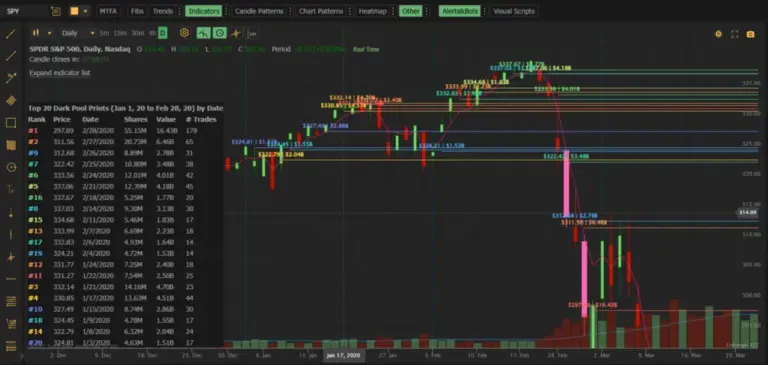
If you want to understand SPY dark pool levels, the useful question is not just whether a big print happened. The useful question is where institutional activity has clustered over time.
That is where dark pool data becomes useful.
One isolated print can be interesting. But when large amounts of off-exchange activity keep showing up around the same price zones, those levels become much more relevant for research.
Using MobyTick dark pool data from March 3, 2026 through April 17, 2026, we can see where SPY institutional activity has been concentrated and why those clusters matter more than headline-sized prints alone.
Why SPY dark pool levels matter
SPY is one of the most actively traded ETFs in the market, so dark pool data in SPY is not about tiny niche activity. It is often a direct window into where large participants are transacting meaningful size.
That does not mean every print predicts the next move. It does mean repeated activity can help reveal price areas where institutions were willing to commit serious capital.
For retail traders, that matters because:
- repeated dark pool activity can highlight levels worth tracking
- large cluster zones can provide institutional context that ordinary charts miss
- SPY often acts as a proxy for broader market positioning
45-day SPY dark pool snapshot
Using MobyTick data from 2026-03-03 through 2026-04-17:
- Total SPY dark pool value: about $151.0 billion
- Total SPY dark pool shares: about 227.0 million shares
- Total aggregated prints in sample: 362
- Largest dark pool day in sample: 2026-03-20, with about $23.9 billion in value
- Second-largest day: 2026-04-17, with about $8.64 billion in value
During the same period, SPY traded in a cash range from roughly 629.28 to 712.39, starting the sample with a close near 680.33 and ending it near 710.14.
That gives us a useful backdrop: institutional activity was spread across a meaningful range, but it was not evenly distributed.
The most important SPY dark pool clusters
When we bucket the prints by price level, the heaviest concentration zones by dollar value show up around these areas:
| SPY Level | Approx. Dark Pool Value | Approx. Shares | Aggregated Prints |
|---|---|---|---|
| 657 | $14.23B | 21.67M | 76 |
| 658 | $9.72B | 14.78M | 94 |
| 662 | $8.49B | 12.83M | 70 |
| 648 | $6.45B | 9.96M | 64 |
| 686 | $6.33B | 9.23M | 64 |
| 669 | $6.23B | 9.32M | 40 |
| 659 | $5.67B | 8.61M | 54 |
| 653 | $5.62B | 8.60M | 14 |
The biggest takeaway is obvious: the heaviest institutional concentration in this sample sits in the mid-650s to low-660s.
That does not mean SPY must trade back there. It does mean that this zone deserves more attention than a random print at an isolated price.
Why clustering matters more than a single print
The most useful thing about SPY dark pool data is not one flashy transaction. It is repeated behavior.
A single large print can happen for many reasons. A cluster of repeated prints around similar prices is more informative because it shows that substantial size kept transacting in the same neighborhood.
In this SPY sample:
- the 657-662 area stands out as the most concentrated institutional zone
- the 648 area also carries meaningful weight
- the upper-680s saw another significant concentration zone around 686
That creates a much better research framework than simply reacting to the latest dark pool headline.
How to interpret SPY dark pool levels without over-reading them
This is where traders usually go wrong.
A dark pool level is context, not prophecy.
Here is the practical way to use the data:
1. Respect the clusters
If billions of dollars in SPY activity repeatedly show up around a narrow range, that range deserves attention.
2. Compare clusters to current price
If price moves far away from a major institutional zone, that does not invalidate the zone. It just changes how you think about it.
3. Use repeated levels, not isolated prints
The cluster is more useful than the lone transaction.
4. Treat dark pool data as one layer of context
Dark pool levels should sit alongside price structure, broader market behavior, and timeframe — not replace them.
Frequently asked questions
What are SPY dark pool levels?
They are price areas where off-exchange institutional SPY transactions have concentrated, often revealing where large participants were willing to transact meaningful size.
Do SPY dark pool levels predict direction?
Not by themselves. They provide context, not certainty.
Why is the 657-662 area important in this sample?
Because that zone carried the largest concentration of SPY dark pool value over the last 45 days in this research pass.
Does one big print matter as much as repeated activity?
Usually no. Repeated activity at similar prices is generally more useful than one isolated print.
Final takeaway
Over the last 45 days, SPY dark pool data shows a clear pattern: the most meaningful institutional concentration sat in the mid-650s to low-660s, with additional weight around 648 and 686.
That does not give you a guaranteed market call. It gives you something more useful: institutional context.
Explore live dark pool activity for free: darkpoolheatmap.com
Go deeper into dark pool research: mobyticktrading.com
Want to go deeper?
Explore Moby Tick or start with the free tool at darkpoolheatmap.com.