The S&P 500 just closed at 6,343 — now over 9% off its highs. The Nasdaq is in correction territory. Oil is hovering near $97 a barrel. And everyone’s asking the same question: is this the bottom?
At MobyTick, we don’t guess. We follow the money. And this week, the dark pool data is painting a picture that’s more nuanced than the headline panic suggests. Let’s break it down.
The Big Picture: Why Markets Are Selling Off
Before we dive into the dark pool prints, let’s set the stage. Three forces are driving this selloff simultaneously:
- The Iran-U.S. conflict has disrupted roughly 17.8 million barrels per day of oil through the Strait of Hormuz. Oil prices have surged nearly 40% since the conflict began on February 28th.
- Recession risk is climbing. Moody’s AI-driven recession model puts the probability at 49% — and every time it’s crossed 50% in its 80-year backtest, a recession followed within a year. The U.S. economy shed 92,000 jobs in February, and GDP was revised down to just 0.7%.
- The Fed is boxed in. Chair Powell stated Monday that policy is in a “good place” and signaled no rate hike — but with inflation estimates being revised upward to 3.8%–4.2%, the disinflationary narrative is breaking down.
That’s the narrative. Now let’s look at what the institutions are actually doing with their money.
What the Dark Pool Block Trades Reveal
We scanned every dark pool block trade over 400,000 shares from March 24–30. There were 100 massive prints totaling tens of billions in institutional flow. Here’s where the money went:
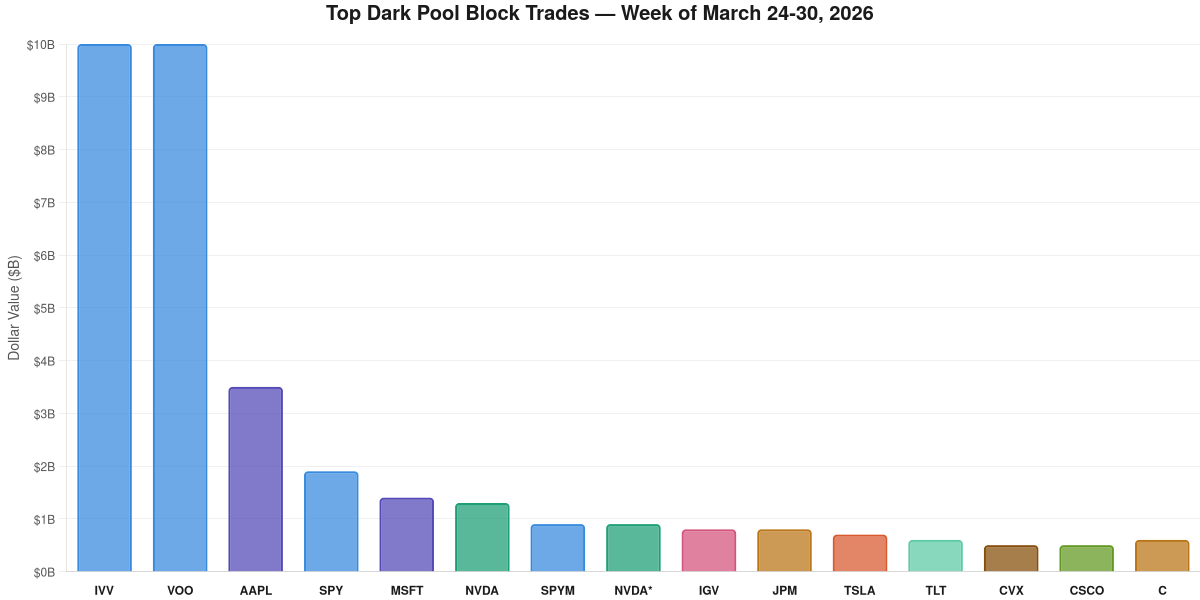
The dominant theme: index rebalancing and defensive positioning. IVV and VOO each printed approximately $10 billion on March 25th alone — these are massive institutional index reconstitution flows. But the individual stock prints tell a more interesting story.
Key Observations:
- AAPL saw a $3.5B print cluster on March 24th at $251.64 — someone with deep pockets was active at that level.
- NVDA printed across multiple days: $1.3B on March 24th, $878M on March 30th — institutions are nibbling even as the stock enters bear market territory (down 21% from highs).
- JPM saw $789M on March 25th and another $767M on March 30th — financials saw major institutional activity.
- TSLA printed $711M on March 30th at $355.51 — a single 2-million-share block.
But here’s the signal buried in the noise: look at the defensive flows. TLT (long-term bonds) printed $561M. BIL (T-bills) printed $532M. AGG (aggregate bonds) printed over $1.2B across multiple days. Institutions are hedging. They’re active in equities and parking cash in safety trades simultaneously.
SPY Dark Pool Rays: The Support and Resistance Map
This is where it gets really actionable. MobyTick’s ray system identifies the specific price levels where institutions have placed large block trades, creating support and resistance zones that technical analysis alone can’t see.
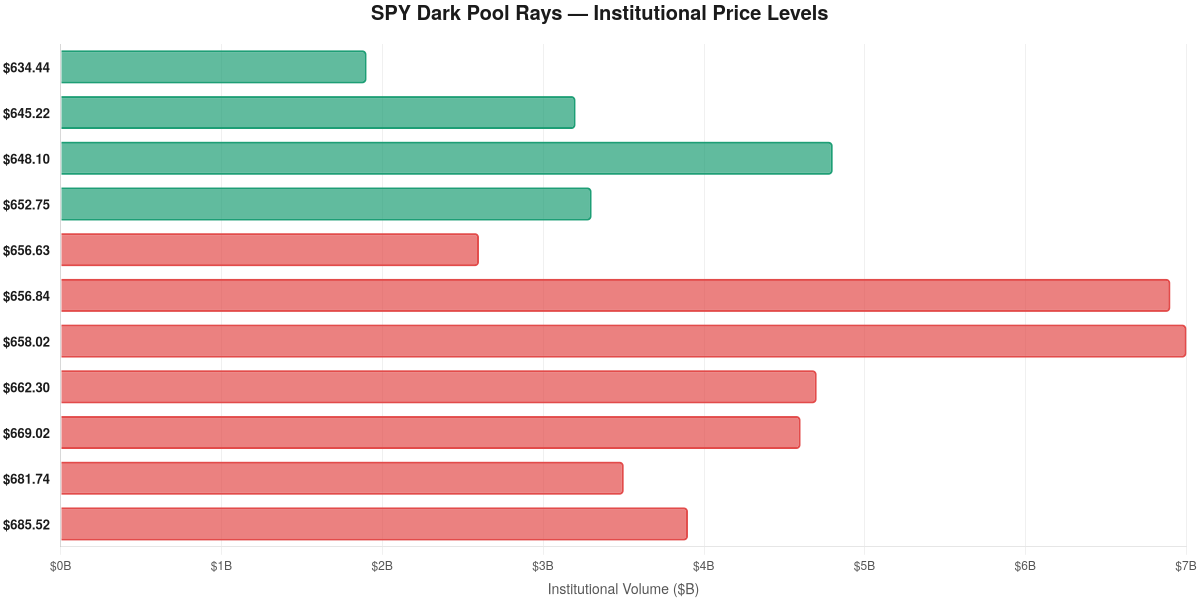
The verdict: 16 out of 20 SPY rays are broken.
That tells you how violent this decline has been. Institutions put money to work at $685, $681, $669, $662, $658, $656 — and price has sliced through every single one of those levels. Those broken rays now act as overhead resistance. Any rally attempt will face institutional sellers looking to get out at breakeven.
The Levels That Matter Right Now:
| Level | Volume | Status | Significance |
|---|---|---|---|
| $634.44 | $1.9B | ✅ Holding | Immediate dark pool support — Monday’s institutional floor |
| $645.22 | $3.2B | ✅ Unbroken | First major overhead resistance |
| $648.10 | $4.8B | ✅ Unbroken | Heavy overhead — key to any recovery |
| $652.75 | $3.3B | ✅ Unbroken | Upper resistance ceiling |
| $656.63 | $2.6B | ❌ Broken | Former support turned resistance |
| $658.02 | $7.0B | ❌ Broken | Massive broken level — strong resistance |
The critical level is $634.44. This is fresh support from March 30th with $1.9 billion in institutional volume behind it. As long as this level holds, the dark pool data suggests institutions are drawing a line in the sand here.
SPY Price Action vs. Dark Pool Levels
Here’s the week mapped out — daily highs and lows against the key dark pool levels:
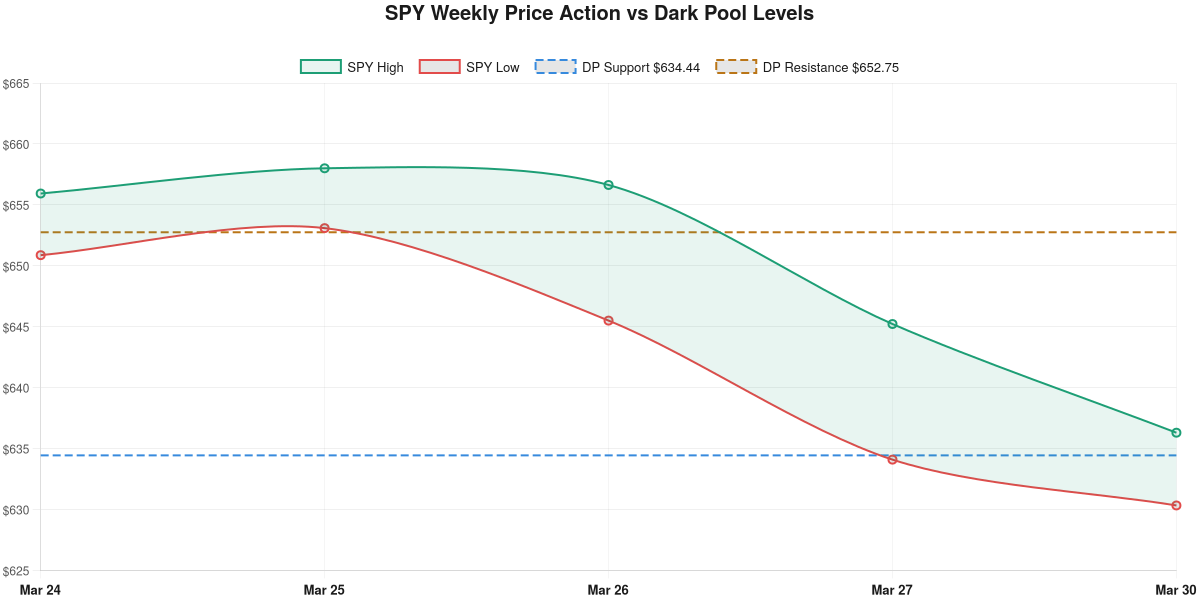
Notice the pattern: each day’s range is compressing toward the $634.44 support. Monday’s (March 24) range was $650–$656. By Thursday (March 27), it had dropped to $634–$645. Monday March 30 tightened further around $630–$636. Price is being funneled toward a decision point.
Sector Flow Breakdown: Where Is Institutional Money Moving?
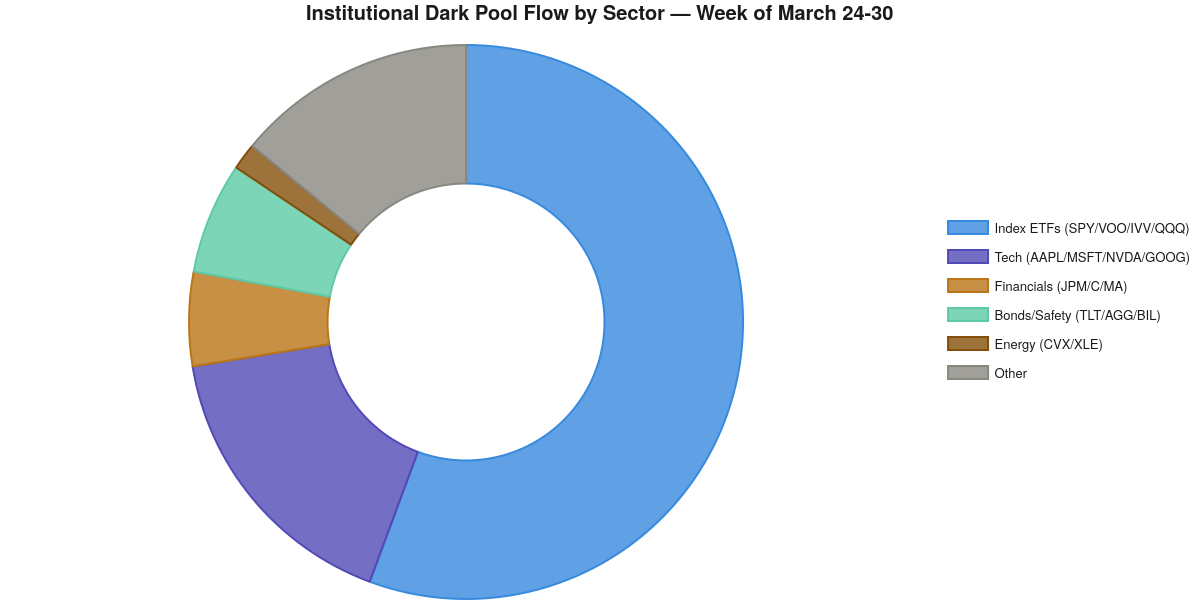
Beyond individual trades, the sector-level view reveals the institutional positioning strategy:
The Playbook:
- Index ETFs dominate — Over $32B in SPY/VOO/IVV/QQQ flow. Much of this is mechanical (rebalancing, reconstitution), but the sheer volume tells you institutions are repositioning at scale.
- Tech is selective, not abandoned — $9.8B in dark pool flow to AAPL, MSFT, NVDA, and GOOG. They’re not dumping tech wholesale — they’re being selective. AAPL and MSFT prints were concentrated at specific price levels, suggesting targeted activity rather than panic.
- Financials saw major activity — JPM and Citigroup saw major block prints. This makes sense: banks benefit from higher-for-longer rates, and if oil stays elevated, energy financing becomes a tailwind.
- The safety trade is real — $3.8B flowing to TLT, AGG, and BIL. This is institutional hedging. They’re active in equities with one hand and parking cash in bonds with the other. Classic late-cycle positioning.
- Energy is quiet — Only $900M in CVX/XLE. Despite oil being the story of the year, institutions aren’t chasing energy stocks in the dark pool. This could mean they think the oil spike is temporary — or that energy stocks have already priced it in.
NVDA and QQQ: The Canaries in the Coal Mine
Two names deserve special attention because they’re telling a story about tech and risk appetite:
NVDA has 19 out of 20 rays broken. The only support level is Monday’s $165.17 ($355M print). Every other institutional entry from $177 down to $172 has been broken. This stock is in a free fall through dark pool support — institutions have been catching falling knives all month. NVDA is now in official bear market territory, down over 21% from highs.
QQQ is even more alarming. All 20 rays are broken except one at $562.66, and the current price ($561.15) is already testing below it. If this level breaks, there is no dark pool support below in the recent data. Watch this like a hawk.
So, Is This the Bottom?
Here’s our honest take, based strictly on what the dark pool data is telling us:
Arguments for a bottom forming here:
- SPY $634.44 is fresh, heavy support with $1.9B of institutional volume. It was set just Monday and is holding.
- The delta-hedge selling thesis suggests that March expiration week accentuated the selloff mechanically, and these kinds of technical breakdowns are typically short-lived.
- The Fed isn’t hiking. Powell’s comments Monday were about as dovish as they could be given the circumstances.
- Selective tech activity (AAPL $3.5B, MSFT $1.4B) shows institutions aren’t in full panic mode.
Arguments that we haven’t bottomed yet:
- The April 6th Iran deadline is the wildcard. Trump paused the energy infrastructure strikes for 10 days. If talks fail and strikes resume, oil goes higher and SPY goes lower.
- The broken-ray count is extreme. Having 16/20 SPY rays broken, 19/20 NVDA rays broken, and 20/20 QQQ rays broken is not the signature of a market finding its footing. It’s the signature of a market in active distribution.
- Bond and T-bill flow signals that institutions are preparing for more downside, not positioning for a V-shaped recovery.
- JPMorgan sees S&P 6,000 as a downside scenario — that’s SPY $600, another 5.5% below current levels.
Our Read:
We’re not at the bottom yet, but we’re approaching an institutional accumulation zone. The dark pool data shows institutions testing price levels and building positions — but they’re doing it with one foot out the door (hence the bond activity). The April 6th deadline is the catalyst that will determine whether $634 holds or we get a flush toward $600.
What to watch this week:
- Does SPY hold $634.44? If this ray breaks on volume, the next support zone may not form until the low $600s.
- Does QQQ’s $562.66 ray hold? This is the tech bellwether. A break here signals broader tech capitulation.
- Oil prices. Every $10 move in oil adds 0.3–0.5% to inflation expectations and shifts the entire calculus.
- The April 6th Iran negotiation deadline. This is the binary event that everything else hinges on.
Follow the Money
The dark pool doesn’t lie. It doesn’t trade on emotion or headlines. It shows you where billions of dollars are being placed by the world’s largest institutions — and right now, they’re telling us they see value at these levels, but they’re not yet confident enough to go all-in.
That’s the kind of signal that typically precedes a bottom — but the “when” depends entirely on the geopolitical resolution. Until then, watch the rays, follow the prints, and let the institutions show you the way.
Want real-time dark pool data and institutional price levels for every stock? Start your MobyTick trial today and see what the smart money sees.
Data sourced from MobyTick’s proprietary dark pool database covering 10,000+ stocks with 5+ years of historical block trade data.