A lot of traders confuse dark pool scanners and options flow scanners because both sound like they track “smart money.”
That is where the confusion starts.
These tools are related, but they do not measure the same thing.
A dark pool scanner tracks reported off-exchange stock transactions, often tied to institutional-sized participation. An options flow scanner tracks activity in the options market, where traders are buying and selling contracts on underlying stocks and ETFs.
If you expect one tool to answer the other tool’s question, you will end up misreading both.
The practical difference is simple:
- dark pool scanners help you study institutional stock trading activity
- options flow scanners help you study activity in the options market
Many traders benefit from using both. But you need to understand what each one is actually showing you.
Why traders confuse these tools
They get grouped together because both are used to track unusually important market activity.
Retail traders often hear phrases like:
- smart money
- institutional activity
- unusual flow
- block trades
And then everything gets blended into one mental bucket.
But the market mechanics are different.
A dark pool print and a large options sweep are not the same event. They may be related in some cases, but they are still different forms of activity that need different interpretation.
What a dark pool scanner measures
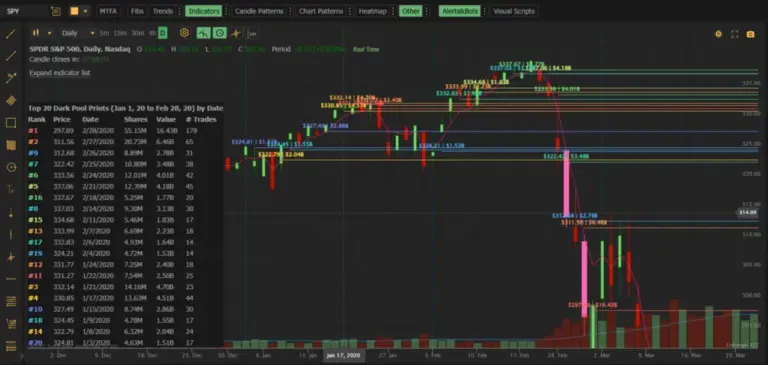
A dark pool scanner focuses on reported off-exchange stock trades, often large transactions executed away from public exchanges.
What traders usually care about here:
- transaction size
- price level
- repeated activity at similar levels
- historical institutional participation by ticker
- sector or ETF concentration
Dark pool scanners are useful when you want to know:
- where institutions have traded stock
- whether a ticker is seeing unusual off-exchange activity
- which price levels have attracted repeated institutional size
In other words, dark pool scanners are more about stock-level institutional transaction context.
What an options flow scanner measures
An options flow scanner focuses on activity in the options market.
What traders usually care about here:
- unusual contract volume
- premium size
- strike selection
- expiration selection
- whether the order looks notable relative to normal activity
- whether traders are focusing on calls, puts, sweeps, blocks, or other structures
Options flow scanners are useful when you want to know:
- where unusual options activity is showing up
- how traders are positioning through options
- whether activity is concentrated in certain expirations or strikes
In other words, options flow scanners are more about derivatives-market activity, not direct stock transactions.
Dark pool scanner vs options flow scanner: side-by-side
| Category | Dark Pool Scanner | Options Flow Scanner |
|---|---|---|
| Tracks | Reported off-exchange stock trades | Activity in the options market |
| Core unit | Shares and trade price | Contracts, premium, strikes, expirations |
| Best for | Institutional stock-trade context | Options positioning and unusual derivatives activity |
| Useful questions | Where did institutions transact stock? | Where is unusual options activity showing up? |
| Best workflow | Historical levels, ticker research, block-trade review | Live options monitoring, strike analysis, derivatives sentiment/context |
| Common mistake | Treating one print like a guaranteed signal | Treating options flow like guaranteed certainty |
When to use a dark pool scanner
Use a dark pool scanner when your goal is to understand where institutional stock activity has shown up.
It is especially useful if you care about:
- institutional price levels
- repeated activity in the same ticker
- block-trade history
- ETF and sector-level dark pool behavior
- off-exchange context that may not be obvious from price alone
Dark pool scanners are often strongest when used for:
- historical ticker research
- studying clusters of institutional activity
- identifying where large participants have repeatedly transacted
When to use an options flow scanner
Use an options flow scanner when your goal is to understand how traders are positioning in the options market.
It is especially useful if you care about:
- unusual contract activity
- premium concentration
- strike and expiration behavior
- option-based positioning themes
- live derivatives activity
Options flow scanners are often strongest when used for:
- daily live scanning
- identifying unusual contract behavior
- watching where traders are concentrating premium
When using both makes sense
This is where things get interesting.
A trader might use a dark pool scanner to understand:
- where institutions have transacted stock
- whether a level has historical importance
Then use an options flow scanner to understand:
- whether there is notable derivatives activity around that same name
- whether the options market is showing unusual participation
These tools can complement each other, but only if you respect the fact that they measure different things.
Dark pool data can help with stock transaction context. Options flow can help with derivatives positioning context.
One does not replace the other.
Common mistakes traders make
Mistake 1: expecting options flow to explain every dark pool print
It doesn’t. They are different markets.
Mistake 2: expecting a dark pool print to explain options positioning
It may add context, but it does not replace options analysis.
Mistake 3: treating either tool like a crystal ball
Neither tool gives certainty. Both give context.
Mistake 4: confusing stock transactions with derivatives activity
This is the category error that causes most bad interpretation.
Which type of trader benefits most from each?
A dark pool scanner is a better fit if you:
- care most about institutional stock transactions
- want historical price-level context
- prefer a ticker research workflow
- want a more specialized institutional-trading lens
An options flow scanner is a better fit if you:
- focus on unusual options activity first
- trade around strikes, expirations, and premium flows
- want a more options-centric daily workflow
- care most about derivatives-market behavior
Using both makes sense if you:
- want a fuller picture of stock and options activity
- can separate the role of each data type
- want stronger context instead of relying on a single signal type
Frequently asked questions
Is a dark pool scanner the same as an options flow scanner?
No. A dark pool scanner tracks reported off-exchange stock trades. An options flow scanner tracks activity in the options market.
Which one is better for institutional trading analysis?
That depends on which kind of institutional activity you care about. For stock transactions and dark pool prints, use a dark pool scanner. For derivatives positioning, use an options flow scanner.
Can dark pool data and options flow be used together?
Yes. Many traders use both together, but they need to understand that each tool answers a different question.
Which one is better for beginners?
That depends on what you are trying to learn. If you want to understand where stock transactions occurred, start with dark pool data. If you are already focused on options trading, an options flow scanner may feel more natural.
Final takeaway
Dark pool scanners and options flow scanners are not interchangeable.
A dark pool scanner helps you understand off-exchange stock activity. An options flow scanner helps you understand options-market activity.
They can work well together. But only if you stop expecting one to be the other.
Explore dark pool activity first: darkpoolheatmap.com
Go deeper into dark pool research: mobyticktrading.com
—
Want to go deeper?
Explore Moby Tick or start with the free tool at darkpoolheatmap.com.