Physical Address
304 North Cardinal St.
Dorchester Center, MA 02124
Physical Address
304 North Cardinal St.
Dorchester Center, MA 02124

An institutional flow tracker should do one thing really well:
help you see where larger participants are active without burying you in fake certainty.
That is the bar.
The phrase gets abused constantly, but the useful version is straightforward. A real institutional flow tracker should help traders identify:
If it cannot do that, it is probably just another flashy dashboard.
An institutional flow tracker is a tool or workflow built to surface signs of meaningful large-participant activity.
That can include:
The point is not to predict the future. The point is to make institutional participation visible enough to improve research and prioritization.
A lot of products claim to track institutional flow, but what they really do is show a pile of disconnected signals and hope the user supplies the discipline.
The stronger version is simpler:
That sequence matters because institutional flow is mostly useful as a ranking tool. It helps you decide where to spend attention first.
The best trackers help you see where money is clustering before you waste time on random names.
They show which names are truly elevated relative to normal behavior.
They highlight where institutions have been active more than once.
They let you compare today’s activity to recent patterns instead of reacting to one-day noise.
They help you move from market scan to ticker drill-down to chart review.
The embedded chart below is the kind of output an institutional flow tracker should actually produce. Instead of just saying “technology was active,” it compares recent dark pool flow share against SPY sector weights so you can see which sectors are screening overweight or underweight.
In our current three-day snapshot:
That is immediately more useful than a generic “money is moving into tech” statement. It tells you the degree of concentration and helps you rank where capital is leaning most aggressively.
That is exactly what a tracker should do: measure concentration in a way that improves prioritization.
See which sectors are showing the strongest institutional participation.
Pull the names with the strongest unusual activity.
Look for repeated price zones and meaningful notional size.
Ask whether the activity is recurring, building, or fading.
Institutional flow becomes useful when it sharpens level selection and watchlist ranking.
The strongest institutional flow signals usually combine three things:
When all three line up, you usually have something worth deeper work. When only one shows up, the signal is weaker and should be treated more cautiously.
Avoid trackers that:
That stuff sells. It does not help much.
DarkPoolHeatmap.com works well as a free institutional discovery tool. It helps traders quickly see sector and ticker-level activity.
MobyTick Trading is the stronger institutional flow tracker when you want deeper historical context, stronger repeated-level research, and a workflow built around dark pool and block-trade analysis.
A real institutional flow tracker should help you focus faster, rank better, and understand where large participants are actually active.
That is enough. It does not need to pretend it knows the future.
Use DarkPoolHeatmap.com for free discovery and MobyTick Trading when you want stronger history, alerts, and deeper institutional research.
An institutional flow tracker should help traders see where participation is overweight or underweight relative to something stable. The chart below compares recent dark pool flow share with SPY sector weights over the last three days.
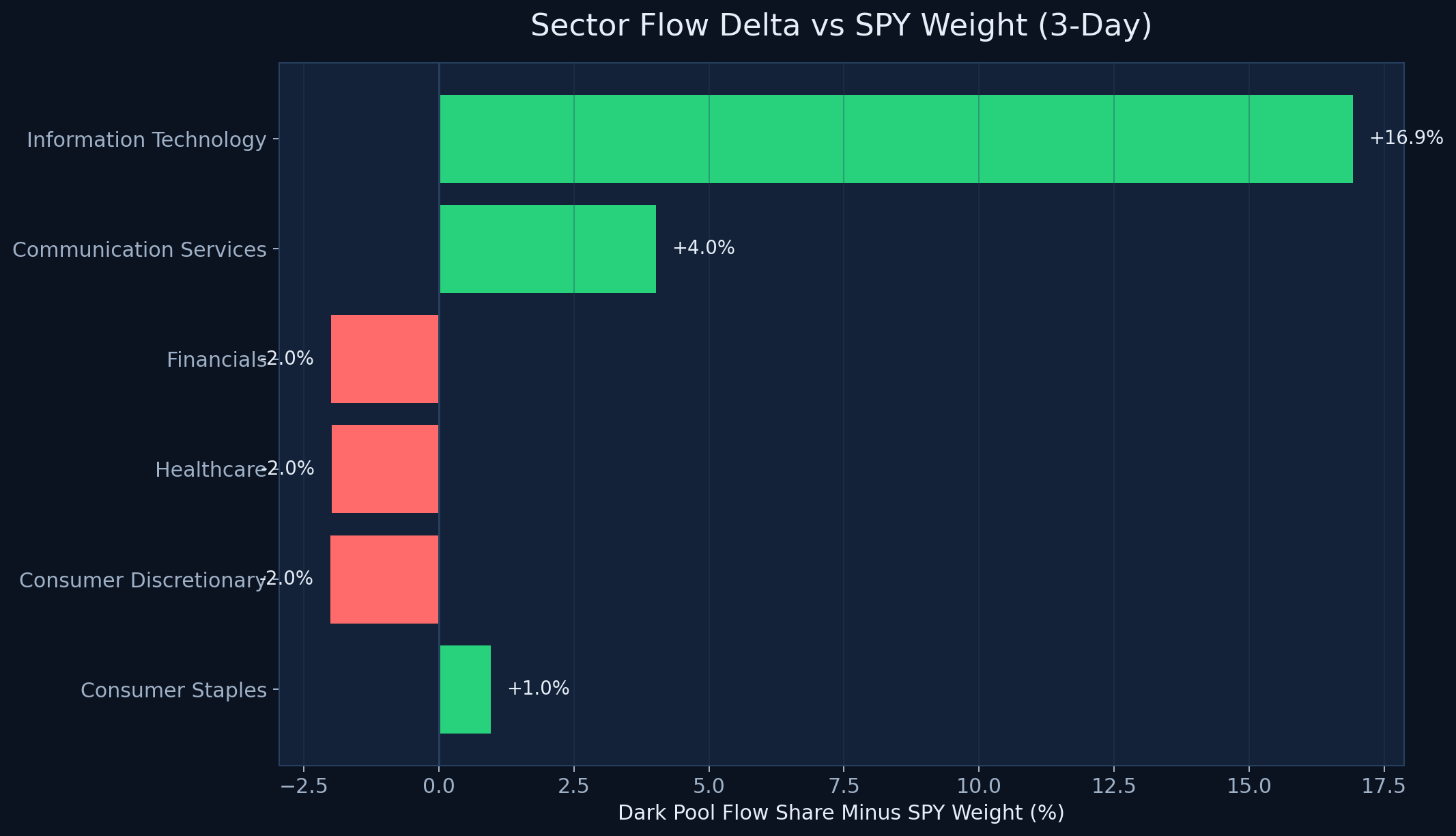
This is the kind of tracker view that actually helps with prioritization. Information Technology screened at roughly +16.9% versus its SPY weight, and Communication Services at about +4.0%. That is a much cleaner read on where capital was leaning than simply saying those sectors were “active.”
By contrast, sectors like Financials and Healthcare were closer to or below their SPY weight in the same window. That contrast is what makes an institutional flow tracker useful: it lets traders decide where the capital concentration is strongest before they spend time drilling into single names.